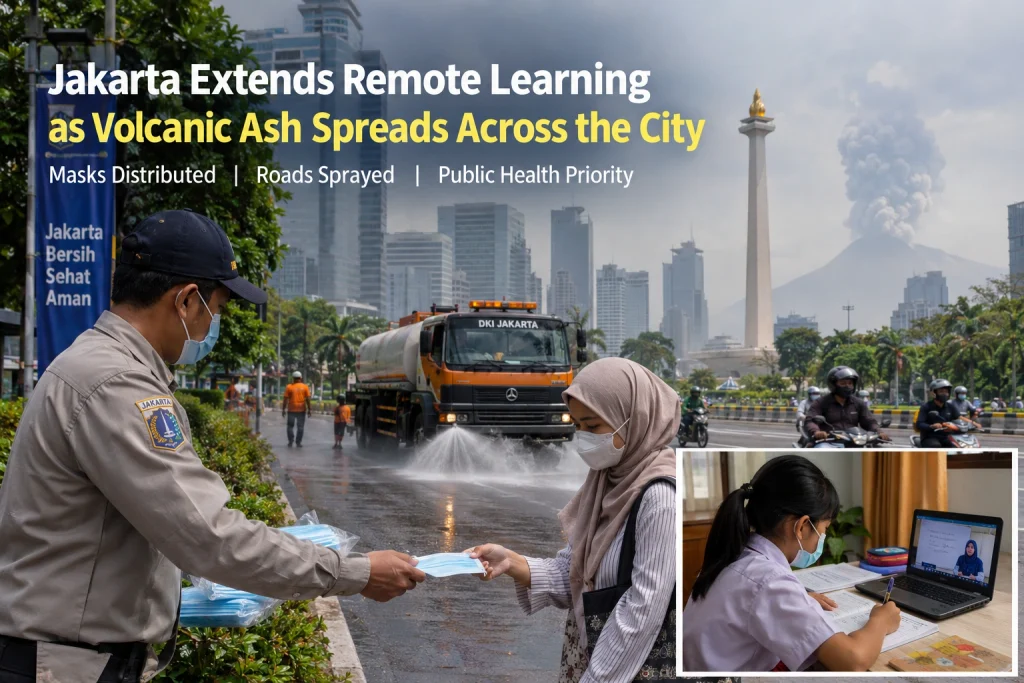
Jakarta, Indonesia — September 7, 2026: Jakarta has extended its remote learning policy as volcanic ash from Mount Anak Krakatau continues to affect parts of the capital, prompting authorities to step up measures to protect public health.
The Jakarta provincial government initially ordered schools to switch to distance learning from September 7 after volcanic ash was detected in the city. On Monday, officials decided to extend the measure through Tuesday, September 8, as some areas were still reporting ash despite an overall improvement in conditions.
The decision highlights the continuing impact of the Anak Krakatau eruption, which has disrupted daily life, transportation and education across parts of Indonesia.
Why Jakarta Is Extending Remote Learning
Jakarta authorities say the temporary shift to online education is primarily a precautionary measure designed to reduce children’s exposure to volcanic ash.
The policy covers public and private educational institutions across multiple levels, including early childhood education, elementary and secondary schools, vocational schools and special education facilities. Officials have stressed that remote learning does not mean schools have stopped operating. Teachers and students are expected to continue lessons from home while authorities monitor the situation.
Jakarta Governor Pramono Anung said Monday that volcanic ash levels had fallen considerably, but some locations were still affected. For that reason, the city decided that another day of remote learning was appropriate while conditions continued to be assessed.
The approach reflects a broader effort to balance educational continuity with health and safety.
Jakarta Steps Up Efforts to Clear Volcanic Ash
The response has not been limited to schools.
Jakarta’s authorities have deployed water-misting equipment and water tanks as part of efforts to reduce the presence of ash on roads and in public areas. According to Jakarta Smart City, the city’s Environmental Agency has deployed a mobile water-mist unit with a 1,000-liter capacity, along with two 5,000-liter water tanks. The urban forest agency has also placed dozens of water tanks and personnel on standby.
Water spraying can help settle ash particles and reduce the amount of material being stirred back into the air by traffic and other activity. The city has also encouraged building managers with suitable water-mist equipment to assist with mitigation around their properties.
Authorities are simultaneously distributing masks and encouraging residents to limit unnecessary outdoor activity while ash remains in the environment.
Volcanic Ash Creates Health Concerns
Volcanic ash is more than an ordinary layer of dust. Fine particles can irritate the eyes, nose and throat, while prolonged exposure can create greater respiratory concerns, particularly for children, older people and individuals who are sensitive to airborne particles.
That is one reason Jakarta has placed particular emphasis on protecting students. Officials have repeatedly advised residents to follow government guidance, monitor official information and take precautions when going outside.
Residents may also need to be careful when cleaning ash from homes, vehicles and outdoor surfaces. Sweeping dry ash can cause particles to become airborne again, making controlled cleaning and protective equipment important.
Anak Krakatau Disrupts Travel Across Indonesia
The Jakarta school closures are part of a much wider disruption caused by the eruption.
The ash cloud has affected aviation operations, with several Indonesian airports temporarily closed because of concerns about volcanic ash and flight safety. Reuters reported that seven airports remained closed on September 7, while nearly 3,000 flights had been cancelled or delayed and around 341,000 travelers were affected.
The eruption has also affected other activities. Schools in areas exposed to ash have moved classes online, while some fishing operations have been suspended as authorities continue monitoring volcanic conditions.
Anak Krakatau remains one of Indonesia’s closely watched volcanoes. Indonesia sits along the Pacific Ring of Fire, a region known for frequent earthquakes and volcanic activity.
What Jakarta Residents Should Do
For residents living in areas affected by ash, authorities are urging people to remain calm and rely on verified information rather than unconfirmed reports circulating online.
People can reduce exposure by limiting unnecessary outdoor activities when ash is present, using appropriate masks and protecting their eyes when conditions require it. Parents should also pay attention to instructions from schools and Jakarta’s government as the remote-learning policy is reassessed.
The city is continuing to monitor air conditions and the distribution of volcanic ash. Officials have indicated that educational arrangements will be reviewed according to developments in the situation.
A Temporary Disruption With a Wider Lesson
Jakarta’s decision to extend remote learning shows how quickly a natural disaster can affect everyday life in a major city.
For students, the immediate priority is staying safe while keeping education moving. For the government, the challenge is managing public health, transportation, environmental cleanup and essential services at the same time.
While volcanic ash levels in Jakarta have reportedly improved, the situation remains fluid. The continued use of masks, road-cleaning measures and remote learning demonstrates that officials are taking a cautious approach until conditions become more stable.
For now, Jakarta residents can expect continued monitoring as authorities assess whether schools can safely return to normal operations. The coming days will be important in determining how quickly the capital can move beyond the disruption caused by the Anak Krakatau eruption.