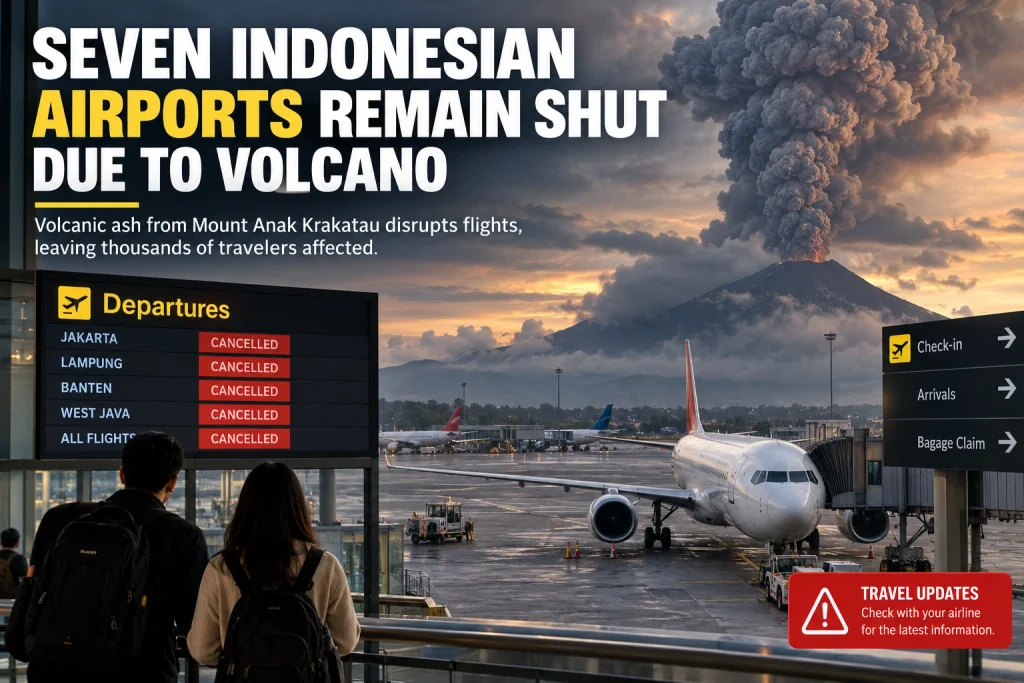
Indonesia’s volcanic activity can quickly turn into a major travel disruption, especially when ash reaches busy flight routes. The airport shutdown story also raises a broader question: how do volcanic eruptions affect air travel, local communities, and the wider tourism economy?
Seven Indonesian Airports Remain Shut Due to Volcano as Ash Disrupts Air Travel
JAKARTA, September 7, 2026 — Seven Indonesian airports, including two serving Jakarta, remained closed on Monday after volcanic ash from Mount Anak Krakatau spread across the region. The disruption has affected hundreds of thousands of travelers and forced airlines to cancel, delay, or divert flights. Authorities have extended the closures while monitoring the ash cloud and checking whether airport operations can safely resume.
The latest eruption has created a major challenge for Indonesia’s aviation network, particularly because Jakarta is one of the country’s most important air travel hubs. The closures are also affecting domestic and international connections, leaving passengers waiting for updated schedules and alternative travel arrangements.
Which Indonesian Airports Are Closed?
According to Indonesia’s Ministry of Transportation, the seven affected airports are:
- Soekarno-Hatta International Airport — Banten
- Halim Perdanakusuma Airport — Jakarta
- Radin Inten II Airport — Lampung
- Budiarto Airport — Banten
- Pondok Cabe Airport — Banten
- Muhammad Taufiq Kiemas Airport — Lampung
- Husein Sastranegara Airport — West Java
The closures were extended until 11:59 p.m. local time on September 7, as officials continued to assess volcanic ash conditions. The ministry said the decision was based on aviation safety concerns, including changing wind directions and the need to ensure ash had moved away from airport areas.
Nearly 3,000 Flights Affected
The scale of the disruption has grown as the eruption continues. By Monday afternoon, Indonesian authorities reported that 2,961 flights had been affected, including cancellations, delays, and diversions. The disruption involved approximately 341,000 passengers across the affected airports.
The figures highlight how quickly a volcanic eruption can create problems far beyond the immediate area. When a major airport closes, aircraft rotations, connecting flights, crew schedules, and terminal capacity can all be affected. Airlines may need to reroute aircraft or adjust their operations even at airports that are not directly covered by ash.
Why Volcanic Ash Is Dangerous for Aircraft
Volcanic ash is more than ordinary dust. It can contain fine particles that are hazardous to aircraft engines and other aviation systems. Ash clouds can also reduce visibility and create difficult operating conditions for pilots and airport staff.
For this reason, airlines and aviation authorities must carefully assess the presence of ash before allowing flights to resume. Even when an eruption appears to be weakening, the risk may remain if winds shift or new ash is released into the atmosphere.
Indonesia’s Transportation Ministry has emphasized that safety remains the main priority. Airport operators are also preparing for the necessary inspections and cleaning of runways, taxiways, and aprons before operations can return to normal.
What Travelers Should Know
Passengers traveling through Jakarta, Lampung, or other affected airports should check directly with their airlines before heading to the airport. Flight schedules may change quickly, and travelers should not assume that a delayed flight will operate at its original time.
Airlines may offer rebooking or refund options depending on their policies and the circumstances of the disruption. Travelers with connecting flights should also confirm whether their onward journeys have been affected.
The airport closures are a reminder that volcanic activity can disrupt travel even when there is no immediate evacuation order for nearby residents. Authorities have urged people to remain alert and follow official safety guidance while the situation develops.
Anak Krakatau’s History and Ongoing Risk
Mount Anak Krakatau is located in the Sunda Strait between Java and Sumatra. It is the volcanic island that emerged from the remnants of the catastrophic 1883 Krakatoa eruption.
The volcano remains one of Indonesia’s important geological hazards. Its 2018 eruption triggered a tsunami that killed more than 400 people along the coasts of Java and Sumatra. Although the current disruption is primarily focused on aviation, the volcano’s history explains why authorities continue to monitor its activity closely.
What Happens Next?
The reopening of the seven airports will depend on the latest volcanic ash assessments and aviation safety reviews. Officials have said that some tests at affected airports have shown no ash, but reopening decisions will also depend on the official volcanic ash advisory and the condition of airport infrastructure.
For now, the main priority is to restore air travel without putting passengers, crews, or aircraft at risk. The situation also shows why travelers in Indonesia should keep checking official airline updates during periods of volcanic activity.
The key takeaway: The seven Indonesian airport closures are not simply a short-term travel inconvenience. They demonstrate how a single volcanic eruption can affect a country’s aviation network, disrupt thousands of flights, and create uncertainty for travelers across the region.
Related Topic Ideas
- How Volcanic Ash Affects Aircraft Engines and Flight Safety
- Mount Anak Krakatau Eruption: History, Risks, and Travel Impact
- What Travelers Should Do When Flights Are Cancelled Due to Volcanic Ash
- Why Indonesia’s Volcanoes Frequently Disrupt Air Travel
- Indonesia Airport Closures: How Airlines Manage Major Travel Disruptions