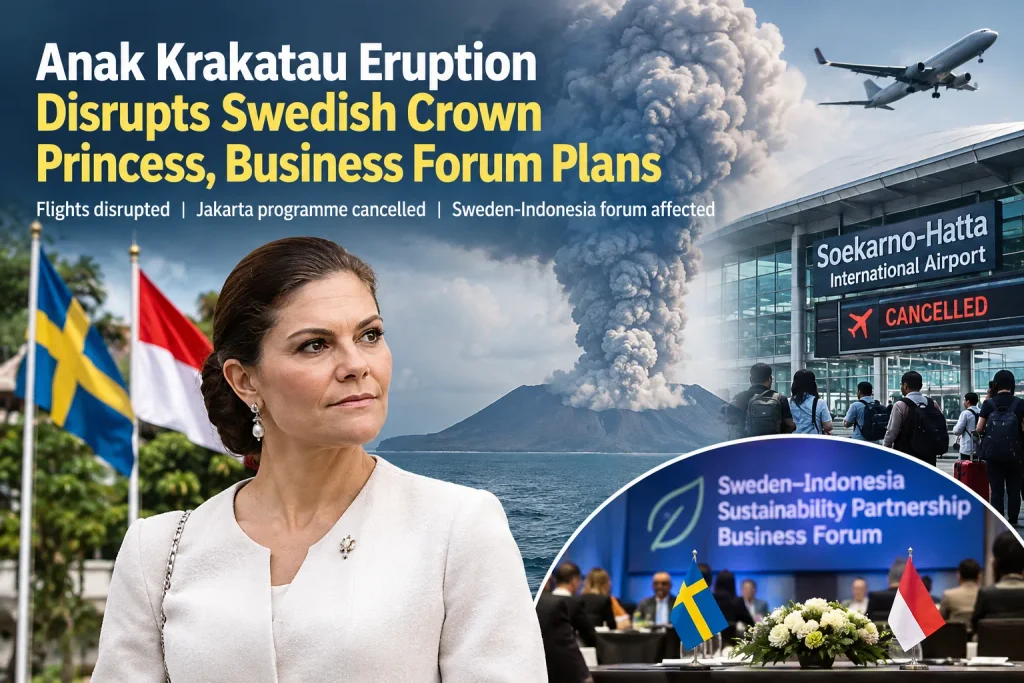
Jakarta, Indonesia — September 7, 2026: The eruption of Mount Anak Krakatau has disrupted more than flights and daily life in Indonesia. The volcanic ash crisis has also forced Sweden’s Crown Princess Victoria to change her travel plans, cancelling a series of planned engagements in Jakarta as authorities continue to deal with widespread aviation disruption.
Crown Princess Victoria arrived in Indonesia on September 4 as a United Nations Development Programme (UNDP) Goodwill Ambassador, with a four-day programme focused on sustainable development, climate action, biodiversity, digital transformation and inclusive economic growth. Her visit was scheduled to include meetings with Indonesian officials, development partners and private-sector representatives.
However, the eruption of Anak Krakatau has created an unpredictable travel situation around Jakarta.
According to Swedish reporting, the Crown Princess’s planned return through Jakarta has been cancelled. Instead, she and her delegation will travel via Bali to avoid becoming stranded in the capital and to ensure they can continue their journey to Europe.
The change comes at a particularly important moment for Sweden-Indonesia relations, with a major Swedish business delegation preparing to participate in a sustainability-focused business forum in Jakarta.
Anak Krakatau Disrupts Air Travel Across Indonesia
Anak Krakatau, located in the Sunda Strait between Java and Sumatra, has been erupting since late Friday. Volcanic ash has spread across western Indonesia, creating serious challenges for aviation.
By Monday, seven Indonesian airports remained closed, including two serving Jakarta. Reuters reported that 2,961 flights had been cancelled, delayed or diverted, affecting about 341,000 travellers. Soekarno-Hatta International Airport, Indonesia’s main international gateway, was among the airports kept closed while crews cleaned runways, taxiways and aircraft operating areas.
The ash cloud has also reached significant heights. Indonesia’s meteorological agency reported ash reaching up to about 50,000 feet in areas toward Sumatra and Banten.
For airlines, volcanic ash presents a serious safety concern because fine particles can damage aircraft engines and reduce visibility. As a result, airport closures and flight cancellations have continued even as volcanic activity showed signs of easing.
That disruption created a difficult situation for an international delegation travelling on a fixed schedule.
Crown Princess Victoria Cancels Jakarta Programme
Crown Princess Victoria’s visit had originally included a return to Jakarta, where she was expected to meet Indonesian President Prabowo Subianto and attend additional engagements.
Swedish court officials confirmed that the Jakarta programme was cancelled because of the travel uncertainty. The decision was made partly to avoid the Crown Princess and her roughly 10-person delegation becoming trapped in Jakarta and potentially missing the funeral of Norway’s King Harald, which is scheduled to take place in Oslo on Wednesday.
The decision illustrates how quickly a natural disaster can alter even carefully planned diplomatic schedules.
Victoria’s Indonesian visit had been designed to highlight cooperation on issues ranging from climate resilience to nature conservation. During the trip, she visited communities and environmental projects, including work related to coral reef protection and sustainable development.
Despite the change to her schedule, the broader objectives of the visit remain significant for both countries.
Swedish Business Delegation Faces a Changed Jakarta Schedule
The volcanic disruption also comes just as a major Swedish business delegation begins its Indonesia programme.
More than 50 companies and Team Sweden organisations, involving more than 100 participants, are taking part in the delegation. Business Sweden and the Swedish Embassy in Indonesia are leading the visit, which runs from September 7 to 10.
The delegation’s agenda covers several sectors that are important to Indonesia’s economic development, including:
- Digitalisation
- Energy
- Mining
- Healthcare
- Forestry
- Transport
One of the central events is the Sweden-Indonesia Sustainability Partnership Business Forum, scheduled for September 8 in Jakarta.
Crown Princess Victoria had been expected to open the forum, linking her UNDP mission with the Swedish business delegation’s programme.
The forum is part of the Sweden-Indonesia Sustainability Partnership, or SISP, which aims to encourage trade, investment, knowledge sharing and practical cooperation between organisations in the two countries. Plans for this year’s event include the launch of a platform focused on responsible forestry and new cooperation agreements between Swedish and Indonesian organisations.
Why the Business Forum Matters
The timing of the business forum is notable because sustainability has become an increasingly important part of Indonesia’s economic strategy.
Indonesia is seeking investment and technology to support areas such as renewable energy, healthcare, digital infrastructure and responsible resource development. Sweden, meanwhile, has positioned many of its companies as providers of technology and solutions related to sustainability, energy efficiency and digital transformation.
Around 80 Swedish-linked companies already operate in Indonesia, according to Business Sweden, working in sectors including manufacturing, telecommunications, transport, energy, healthcare and mining.
The business delegation therefore represents more than a diplomatic visit. It is also an opportunity for companies from both countries to explore commercial partnerships and long-term investment.
The volcanic eruption, however, has introduced an unexpected logistical challenge.
A Visit Focused on Climate Resilience Meets a Natural Disaster
There is an unusual dimension to the disruption.
Crown Princess Victoria’s UNDP programme in Indonesia has focused heavily on climate action, biodiversity and sustainable development. During her visit, she travelled to areas where communities are working to protect ecosystems and strengthen resilience.
On Gili Meno, for example, she visited an initiative involving parametric insurance designed to help protect coral reefs from the effects of rising ocean temperatures. The project is being developed by UNDP with the Indonesian government, Swiss Re and the Ocean Risk and Resilience Action Alliance.
Her programme also included a visit to the Karang Bajo traditional community in North Lombok, where she learned about efforts to protect forests, springs and cultural heritage.
The Anak Krakatau eruption now provides a very immediate example of why disaster preparedness and climate resilience matter.
Indonesia Continues to Monitor the Volcano
Indonesian authorities remain cautious despite improvements in some areas.
Reuters reported that the probability of further eruptions remains high, while volcanic ash continues to affect transportation and public health. Authorities have advised residents to wear masks and eye protection, reduce unnecessary outdoor activity and take care when driving because ash can reduce visibility.
Schools in Jakarta and Lampung have also shifted to remote learning as a precaution against ash exposure.
There was no immediate tsunami threat reported from the current activity, but Anak Krakatau’s history means authorities are maintaining a high level of vigilance. The volcano was responsible for the 2018 tsunami that killed more than 400 people, while the catastrophic 1883 eruption of the older Krakatau killed more than 36,000 people.
What Happens Next for Sweden-Indonesia Relations?
Although Crown Princess Victoria’s Jakarta programme has been cancelled, the disruption does not necessarily signal a setback for Sweden-Indonesia relations.
The Swedish business delegation’s programme and the sustainability partnership were already built around longer-term economic and environmental cooperation. The companies involved will still have opportunities to meet Indonesian partners, explore investments and discuss projects in key sectors.
The volcanic eruption has simply added an unexpected reminder that international business and diplomacy increasingly need to account for climate, environmental and disaster risks.
For Crown Princess Victoria, the immediate priority is completing her journey safely. For Indonesia and Sweden, the larger task remains unchanged: building practical cooperation around sustainability, innovation and inclusive economic growth.
As Anak Krakatau continues to be monitored, the episode demonstrates how a natural event hundreds of kilometres from a diplomatic meeting can have consequences far beyond the volcano itself — reaching airports, schools, businesses and even international relations.