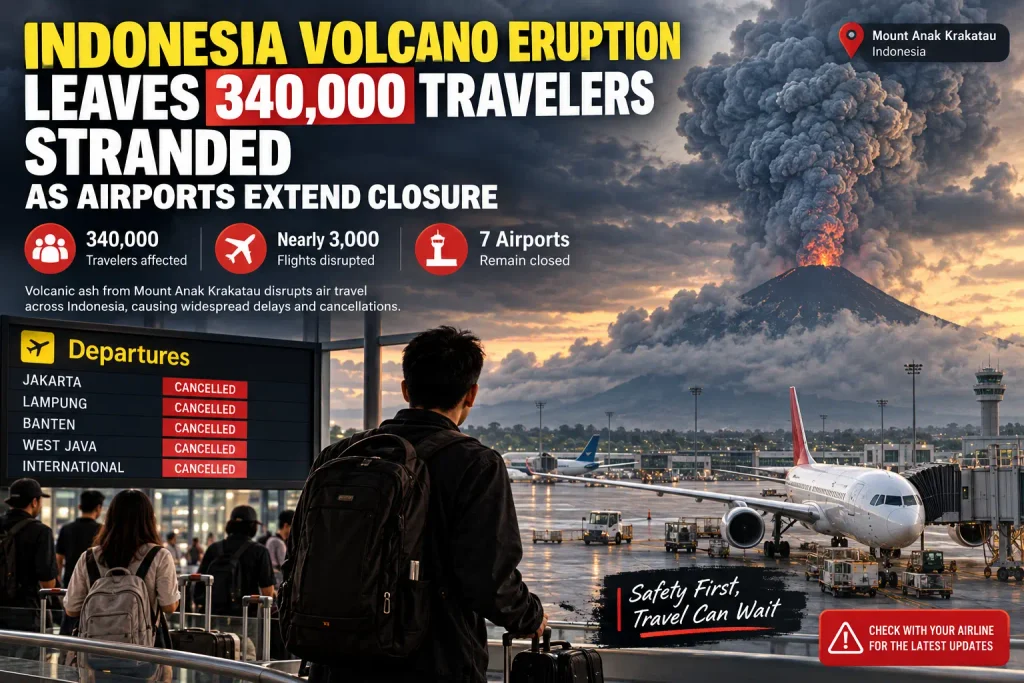
JAKARTA, September 7, 2026 — Volcanic ash from Mount Anak Krakatau has disrupted air travel across Indonesia, affecting approximately 341,000 passengers and nearly 3,000 flights. The eruption forced authorities to extend the closure of seven airports, including Jakarta’s main international gateway, as officials continued to assess conditions and prepare for a safe return to normal operations.
Why the Airport Closures Were Extended
The disruption began after Anak Krakatau erupted late on Friday, sending volcanic ash across parts of Java and Sumatra. Although the most intense phase of the eruption had eased, ash remained a concern for aviation authorities. Changing wind directions could carry particles back toward airports, making it difficult to determine when flights could safely resume.
Indonesia’s Transportation Ministry said the extended closures were a precautionary measure. Officials wanted to ensure that ash had moved away from airport areas and that runways, taxiways, and aircraft could be checked before operations restarted.
Seven Airports Affected Across Java and Sumatra
The closures affected important aviation facilities in Jakarta, Banten, Lampung, and West Java. The airports named in the ministry’s September 7 update were:
- Soekarno-Hatta International Airport — Jakarta’s main international gateway
- Halim Perdanakusuma Airport — Jakarta
- Radin Inten II Airport — Lampung
- Muhammad Taufiq Kiemas Airport — Lampung
- Pondok Cabe Airport — South Tangerang
- Budiarto Airport — Banten
- Husein Sastranegara Airport — West Java
The ministry extended the closures until 11:59 p.m. local time on September 7, while aviation officials continued to monitor the volcanic ash advisory and airport conditions.
Nearly 3,000 Flights Disrupted
The scale of the disruption shows how quickly a volcanic eruption can affect a country’s transport network. According to Indonesia’s Transportation Ministry, 2,961 flights had been affected by Monday afternoon, including 2,339 domestic flights and 622 international flights. The disruptions included cancellations, delays, and diversions.
For travelers, the impact goes beyond waiting for a flight. A cancelled departure can also affect connecting flights, hotel bookings, airport transfers, and plans at the final destination. Airlines must also reorganize aircraft, crews, and passenger bookings when a major airport is temporarily unavailable.
Why Volcanic Ash Is a Serious Aviation Hazard
Volcanic ash is dangerous because it can damage aircraft engines and other systems. Fine ash particles can enter engines, affect visibility, and create difficult conditions for pilots and airport staff.
That is why airport authorities cannot rely only on whether the sky looks clear. They must also consider the latest ash forecasts, wind conditions, and safety inspections. The ministry said airport teams were checking airside infrastructure, while airlines were carrying out their own inspections before resuming services.
Travelers Advised to Check Airline Updates
Passengers affected by the closures should check directly with their airlines for the latest information. Flight schedules may change as airport conditions develop, and travelers should confirm whether their original flight has been cancelled, delayed, or moved to another airport.
The disruption also highlights the importance of having flexible travel arrangements during periods of volcanic activity. Passengers with connecting flights should check their entire itinerary rather than assuming that only the first flight has been affected.
Schools Move to Remote Learning as Ash Spreads
The eruption has also affected daily life beyond airports. Authorities shifted schools in parts of Jakarta and Lampung to remote learning as a precaution against volcanic ash exposure. Residents in affected areas have also had to deal with ashfall around homes and public spaces.
This shows how volcanic eruptions can disrupt communities even when the immediate concern is not a direct lava flow. Ash can affect transport, visibility, air quality, and normal activities across a much wider area.
Anak Krakatau’s History Adds to the Concern
Mount Anak Krakatau is located in the Sunda Strait between Java and Sumatra. It emerged from the remains of the volcano involved in the catastrophic 1883 Krakatoa eruption.
The volcano also became widely known after its 2018 eruption triggered a deadly tsunami. That history explains why Indonesian authorities continue to monitor its activity carefully, even when the immediate disruption is focused on aviation rather than evacuations.
What Happens Next?
The next step is a gradual return to normal air travel, based on official safety assessments. Authorities must determine whether ash has cleared from airport areas and whether aircraft and airport facilities are ready for operations.
Update: By September 8, Indonesia had reopened Jakarta’s Soekarno-Hatta Airport and four other airports after ash conditions improved. However, two airports remained closed while authorities continued their assessments.
The incident is a reminder that volcanic activity can affect international travel far beyond the immediate eruption zone. For passengers planning trips to Indonesia, the best approach is to follow official airline and airport updates and allow extra flexibility when traveling during periods of volcanic activity.